click

Showing posts with label Bicycling manufacturers. Show all posts

Tuesday, December 4, 2012

Colnago


Colnago is a manufacturer of high-end road-racing bicycles founded by Ernesto Colnago in 1954 near Milano in Cambiago, Italy. Instead of following his family's farming business, Ernesto Colnago chose to work in the cycle trade, apprenticing first with Gloria Bicycles at 13, subsequently taking up road racing. After a bad crash ended his racing career, he began subcontracting for Gloria, opened his own shop (1954) and built his first frames the same year. Much in demand as a racing mechanic, he was second mechanic on the Nivea team Giro d'Italiaunder Faliero Masi in 1955, eventually being employed as head mechanic for the Molteni team of Belgian cycling legend Eddy Merckx.
The company first became known for high quality steel framed bicycles, and later as one of the more creative cycling manufacturers responsible for innovations in design and experimentation with new and diverse materials including carbon fiber, now a mainstay of modern bicycle construction. 
From the late 1960s through the 1970s, Colnago was generally regarded as one of the builders of the world's best custom road race frames. In 1960, Colnago saw fame as Luigi Arienti rode to a gold medal at the Rome Olympics on a Colnago bicycle. In 1963, Colnago joined the Molteni team as head mechanic, and riders such as Gianni Motta raced on Colnago bikes. A win on a Colnago in the 1970 Milan-San Remo race by Michele Dancelli for the Molteni team inspired Colnago to change his logo to the now-famous 'Asso di Fiori' or Ace of Clubs.
After the demise of the Faema team, Eddy Merckx joined the Molteni team, and what ensued was mutual innovation—as Colnago describes it: "Merckx was an up and coming champion, and I was an up and coming bike builder. So it was a real honour to work for a great champion like Merckx. It helped us to grow... when we made special forks, and special bikes." This included the super-light steel frame used by Merckx in 1972 to break the world one hour record.
With a growing reputation from their racing wins, Colnago plunged into the market for production bikes. In the U.S., the early seventies witnessed another bike boom, and Colnago "pumped out bikes as though the future of humankind was at stake." The mainstay of the Colnago line in the 1970s was the Super, followed by the Mexico, named in honor of the successful hour attempt. Other models were added including the Superissimo and Esa Mexico. While the finish on these early Colnagos could be variable, they were great riding bikes and developed a cult-like following.
In response to criticism that his frames were not stiff enough, next Colnago experimented with ways to change the behavior of frame components. In 1983, he introduced the Oval CX with an oval-shaped top tube to add stiffness. He then experimented with various crimped-tube frames which became production models as their top of the range frames, beginning with the "Master." Later "Master-Light", Master Olympic and Master Piu extended the range. Colnago built a frame from Columbus tubing used by Giuseppe Saronni to win the world professional road race championship in 1982, and afterwards a short-lived collection of bikes were badged with the Saronni name.
Since the 1980s, while Colnago continued to produce high-end steel bikes, they began to produce bike frames using material other than steel including titanium, aluminum, carbon and mixed material frames. One unique frame from this period, the Bititan, has a dual titanium down tube. Crimped and oversize tubes appeared on the Tecnos–one of the lightest production steel bikes produced, and the same oversize tubes and crimping were used on the aluminum Dream frame. In 1981 Colnago prototyped the CX-1–a full monocoque carbon fiber bike with disc wheels that was shown at the Milan bike show. Subsequently, Colnago worked with Ferrari in developing new carbon fiber technology, and Ernesto also credits their engineers for challenging him regarding fork design, which led to Colnago's innovative Precisa straight-bladed steel fork. They also experimented with multi-material frames, including the CT1 and CT-2 constructed with titanium main tubes, carbon fiber forks and rear stays, and a similarly constructed (although short-lived) Master frame constructed with steel main tubes, carbon forks and stays.
Colnago's early attempts at carbon fiber frames were not commercially successful, but the lessons learned were embodied in their flagship frames, such as the C-40 (1994) and its successor, the C-50–respectively named for Colnago's 40th and 50th years in bike building. These carbon fiber frames set new standards of excellence. Interestingly, they were built using a modified form of traditional bike frame construction, substituting carbon fiber lugs for microinfusion cast steel, and carbon fiber "tubes" for the complex steel tubes used for steel frame construction. Similar building techniques are used in the latest offering, the C59, named (as before) for its year of production.


Cervélo

Cervélo Cycles is a Canadian manufacturer of racing bicycle frames. Cervélo uses CADcomputational fluid dynamics, and wind tunnel testing at a variety of facilities including the San Diego Air and Space Technology Center, in California, USA, to aid its designs. Frame materials include carbon fibre. Cervélo currently makes 3 series of road bikes: the R series, featuring multi-shaped, "Squoval" frame tubes; and the S series of road bikes and P series of triathlon/time trial bikes, both of which feature airfoil shaped down tubes. The company also manufactures T series track bikes.

Cervélo's sponsorshi1p of elite athletes has led to widespread recognition of the brand.
In 2003, Cervélo became the bike supplier to Team CSC, at the time the 14th team on the world ranking. Cervélo was by far the smallest and youngest bike company to ever supply a team at this level. Team CSC has been crowned the world’s #1 pro cycling team aboard Cervélo for three years. The partnership lasted for six years, until the end of 2008.
In 2009, Cervélo became the first bike manufacturer in the modern era to have its own cycling team at the highest levels of racing, Cervélo TestTeam. The team had a stated goal of not only competing successfully on the international level, but also encouraging collaboration between the team members, Cervélo, and other product sponsorship partners in order to develop better products. There was also a strong focus on fan interaction and experiences. The team's most renowned riders were 2008 Tour De France winner Carlos Sastre and 2010 World Champion and 2009 TdF Green Jersey winner Thor Hushovd. Heinrich Haussler also took many of the team's headlines, with his impressive performances at Paris–Nice, Milan – San Remo, and his stage win in the 2009 Tour de France (Stage 13, Colmar).
In 2010, Emma Pooley and Thor Hushovd won the UCI Women's Timetrial and UCI Men's Road Race respectively. Success was also achieved in a number of ITU Triathlon Races and the Ironman 70.3 and long distance events.
For the 2011 season Cervélo have joined forces with Slipstream sports to form the Garmin-Cervélo team which also includes a women's team.

Cannondale

The Cannondale Bicycle Corporation, is an American division of Canadian conglomerate Dorel Industries that supplies bicycles. It is headquartered in Bethel, Connecticut with manufacturing and assembly facilities in China and Taichunghe company was founded in 1971 by Joe Montgomery, Jim Catrambone and Ron Davis to manufacture backpacks and bags for camping and later bicycle trailers for bicycle touring. One of the most successful products was the Bugger, a child trailer, although Cannondale's marketing department seemed unaware of the connotations of the name in British English (some were, nevertheless, exported to the UK). Today, Cannondale produces many different types of high-end bicycles, few of which are handmade in USA, specializing in aluminum (rather than steel or titanium) and carbon fiber frames, a technology in which they were pioneers. The name of the company was taken from the Cannondale Metro North train station in Wilton, Connecticut.In the late 1990s Cannondale attempted to move into the motorsports business, producing a line of off-road motorcycles and all-terrain vehicles. According to an interview with Cannondale Communications Director, Tom Armstrong, the company was unable to drive down the cost of their motor vehicles fast enough. Sales took off when the company was still losing money on each motorbike they shipped. This gap drove the company to seek bankruptcy protection in 2003, and to sell off the motorsport division. Cannondale's bicycle division was purchased in 2003 by Pegasus Capital Advisors, which supported the company's renewed focus on bicycle production. In February 2008, Cannondale was purchased from Pegasus Capital Advisors by Dorel Industries. In April 2009 it was announced that all production would be transferred to Taiwan. 

-Sponsorship

Cannondale's sponsorship of Division 1 road racing teams began with the Saeco team in the late 1990s, highlighted by Mario Cipollini's four consecutive stage wins in the 1999 Tour de France. The team notably won the Giro d'Italia five times, in 1997 with Ivan Gotti, in 2003 with Gilberto Simoni in 2004 with Damiano Cunego. Saeco became Lampre-Caffita in 2005, and the relationship with Cannondale was severed.
In 2007, Cannondale became the bicycle sponsor to Liquigas, and counted fourth and fifth Giro wins as Danilo Di Luca in 2007 and Ivan Basso in 2010 rode to victory. In 2011, they became a title sponsor under the name Liquigas-Cannondale. They also sponsored UCI Professional Continental team Barloworld in 2007 on the Tour de France and UCI Continental team Bahati Foundation in 2010.

Trek


Trek Bicycle Corporation is a major bicycle and cycling product manufacturer and distributor under brand names Trek, Gary Fisher, Bontrager, Kleinand until 2008, LeMond Racing Cycles. With its headquarters in Waterloo, Wisconsin, Trek bicycles are marketed through 1,700 dealers across North America, subsidiaries in Europe and Asia as well as distributors in 90 countries worldwide.Trek's domestic high-end frames are manufactured in Waterloo, Wisconsin with assembly in Whitewater, Wisconsin — with the majority of company's bicycles manufactured in Taiwan and China.
In December, 1975, Richard (Dick) Burke and Bevil Hogg established Trek Bicycle as a wholly owned subsidiary of Roth Corporation, a Milwaukee-based appliance distributor. In early 1976, with a payroll of five, Trek started manufacturing steel touring frames in Waterloo, Wisconsin, taking aim at the mid to high-end market dominated by Japanese and Italian made models. Trek built nearly 900 custom hand-brazed framesets that first year, each selling for just under $200. Later that same year Trek Bicycle was incorporated. In 1977, Penn Cycle became the first Trek dealer in the world. Within three years, Trek sales approached $2,000,000.

Trek becomes a business

Hampered without additional manufacturing capacity, Trek sales plateaued in the late 1970s. In just a few short years Trek had outgrown its original “red barn” manufacturing facility—a former carpet warehouse. Recognizing the need for expansion, in 1980 Trek broke ground on a new 26,000 sq ft (2,400 m2) corporate headquarters on the outskirts of Waterloo. Company co-founder Dick Burke would later recall that “it wasn’t until we built the new factory that we became a business.” With more factory space available, Trek expanded its manufacturing to include complete bikes. In 1982 Trek entered the steel road racing bike market, introducing the 750 and 950 models, and in 1983 Trek built its first mountain bike, the 850. In 1984 Trek ventured into the aftermarket parts and accessories business, launching its Trek Components Group (TCG) department.
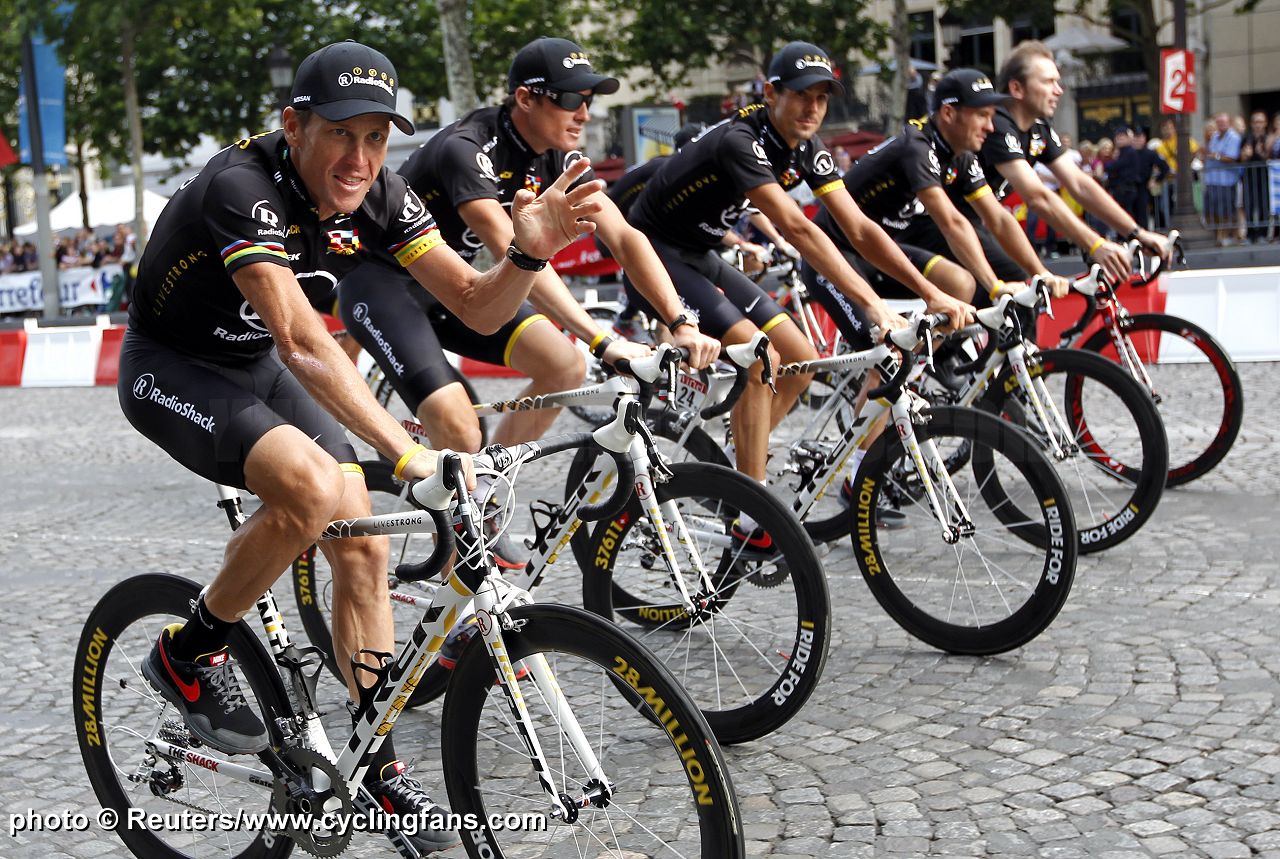
The most famous team to use the Trek bikes is Radioshack Nissan Trek Team from USA.