click

Showing posts with label Tour de France. Show all posts

Monday, December 3, 2012

Tour de France part.3

Riders aim to win overall but there are three further competitions: points, mountains and for the best young rider. The leader of each wears a distinctive jersey. A rider who leads more than one competition wears the jersey of the most prestigious. The abandoned jersey is worn by the second in the competition. The Tour's colours have been adopted by other races and have meaning within cycling generally.


The yellow jersey (maillot jaune) is worn by the general classification leader. This is decided by totalling the time each rider takes on the daily stages. The rider with the lowest overall time at the end of each stage receives a ceremonial yellow bicycling jersey and the right to start the next stage of the Tour, usually the next day, in the yellow jersey. The rider to receive the yellow jersey after the last stage in Paris, is the overall winner of the Tour.
The very first rider to wear the yellow jersey from start to finish was Ottavio Bottecchia of Italy in 1924.Nicolas Frantz (1928) and Romain Maes (1935) are the only two other riders who have done the same. The first company to pay a daily prize to the wearer of the yellow jersey – known as the "rent" – was a wool company, Sofil, in 1948. The greatest number of riders to wear the yellow jersey in a day is three: Nicolas Frantz, André Leducq and Victor Fontan shared equal time for a day in 1929 and there was no rule to split them. 
The riders with most wins:
Jacques Anquetil in 1957, 1961, 1962, 1963 and 1964
Eddy Merckx in 1969, 1970, 1971, 1972 and 1974
Bernard Hinault in 1978, 1979, 1981, 1982 and 1985
Miguel Indurain in 1991, 1992, 1993, 1994 and 1995 (the first to do so in five consecutive years).
In this pool would also be Lance Armstrong but with the ban that he recived, he isn't(resulted with lossing all the titles).
The green jersey (maillot vert) is given to the leader of the points classification. At the end of each stage, points are earned by the riders who finish first, second, etc. More points are given for flat stages and fewer for mountain stages. The points competition began in 1953, to mark the 50th anniversary. It was called the Grand Prix du Cinquentenaire and was won by Fritz Schaer of Switzerland. The first sponsor was La Belle Jardinière. The current sponsor is Pari Mutuel Urbain, a state betting company. Currently, the points classification is calculated by adding up the points collected in the stage and subtracting penalty points. Points are rewarded for a high finishing position in a stage or at an intermediate sprint. One rider has won the points competition six times - Erik Zabel 1996, 1997, 1998, 1999, 2000, 2001 (consecutive years).
The King of the Mountains wears a white jersey with red dots (maillot à pois rouges), inspired by a jersey that one of the organisers, Félix Lévitan, had seen at the Vélodrome d'Hiver in Paris in his youth. The competition gives points to the first to top designated hills and mountains.
The best climber was first recognised in 1933, prizes were given from 1934, and the jersey was introduced in 1975. The first to wear the mountain jersey was Lucien Van Impe, who earned the honour en route to his third mountains title.
Between 1975 and 1989, and since 2000, there has been a competition for young riders. The rider aged under 26 who places highest in the GC gets to wear a white jersey (maillot blanc).
Since the young rider classification was introduced in 1975, it has been won by 29 different cyclists. Of those, six cyclists also won the general classification during their careers (Fignon, LeMond, Pantani, Ullrich, Contador and Schleck). On four occasions a cyclist has won the young rider classification and the general classification in the same year—Fignon in 1983, Ullrich in 1997, Contador in 2007 and Schleck in 2010.
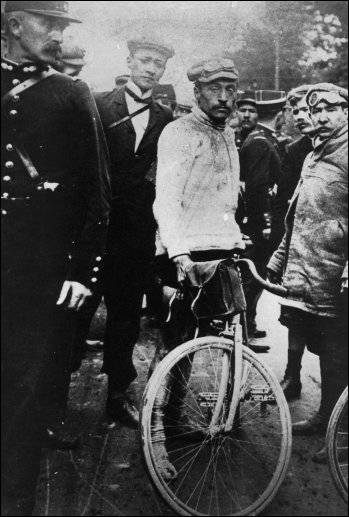
And at the end one of the most famous wins on the tour.



Tour de France part.2

-The idea for the tour

L'Auto was not the success its backers wanted. Stagnating sales lower than the rival it was intended to surpass led to a crisis meeting on 20 November 1902 on the middle floor of L'Auto's office at 10 Rue du Faubourg Montmartre, Paris. The last to speak was the most junior there, the chief cycling journalist, a 26-year-old named Géo Lefèvre. Desgrange had poached him from Giffard's paper. Lefèvre suggested a six-day race of the sort popular on the track but all around France. Long-distance cycle races were a popular means to sell more newspapers, but nothing of the length that Lefèvre suggested had been attempted. If it succeeded, it would help L'Auto match its rival and perhaps put it out of business. It could, as Desgrange said, "nail Giffard's beak shut." Desgrange and Lefèvre discussed it after lunch. Desgrange was doubtful but the paper's financial director, Victor Goddet, was enthusiastic. He handed Desgrange the keys to the company safe and said: "Take whatever you need." L'Auto announced the race on 19 January 1903.

-The first Tour de France

The first Tour de France was staged in 1903. The plan was a five-stage race from 31 May to 5 July, starting in Paris and stopping in Lyon, Marseille, Bordeaux and Nantes before returning to Paris. Toulouse was added later to break the long haul across southern France from the Mediterranean to the Atlantic. Stages would go through the night and finish next afternoon, with rest days before riders set off again. But this proved too daunting and the costs too great for most and only 15 entered. Desgrange had never been wholly convinced and he came close to dropping the idea. Instead, he cut the length to 19 days, changed the dates to 1 to 19 July, and offered a daily allowance  to those who averaged at least 20 km/h on all the stages. That was what a rider would have expected to earn each day had he worked in a factory. He also cut the entry fee from 20 to 10 francs and set the first prize at 12,000 francs and the prize for each day's winner at 3,000 francs. The winner would thereby win six times what most workers earned in a year. That attracted between 60 and 80 entrants – the higher number may have included serious inquiries and some who dropped out – among them not just professionals but amateurs, some unemployed, some simply adventurous.
The first Tour de France started almost outside the Café Reveil-Matin at the junction of the Melun and Corbeil roads in the village of Montgeron. It was waved away by the starter, Georges Abran, at 3:16 p.m. on 1 July 1903. Among the competitors were the eventual winner, Maurice Garin, his well-built rival Hippolyte Aucouturier, the German favourite Josef Fischer, and a collection of adventurers including one competing as "Samson".
The race finished on the edge of Paris at Ville d'Avray, outside the Restaurant du Père Auto, before a ceremonial ride into Paris and several laps of the Parc des Princes. Garin dominated the race, winning the first and last two stages, at 25.68 km/h. The last rider, Millocheau, finished 64h 47m 22s behind him.

Tour de France part.1


The Tour de France is an annual multiple stage bicycle race primarily held in France, while also occasionally making passes through nearby countries. The race was first organized in 1903 to increase paper sales for the magazine L'Auto it is currently run by the Amaury Sport Organisation. The race has been held annually since its first edition in 1903 except for when it was stopped for the two World Wars. As the Tour gained prominence and popularity the race was lengthened and its reach began to extend around the globe. Participation expanded from a primarily French field, as riders from all over the world began to participate in the race each year. The Tour is a UCI World Tour event, which means that the teams that compete in the race are mostly UCI ProTeams, with the exception of the teams that the organizers invite.
Along with the Giro d'Italia and Vuelta a España, the Tour makes up cycling's prestigious, three-week-long Grand Tours. Traditionally, the race is usually held primarily in the month of July. While the route changes each year, the format of the race stays the same with the appearance of at least two time trials, the passage through the mountain chains of the Pyrenees and the Alps, and the finish on the Champs-Élysées. The modern editions of the Tour de France consist of 21 day-long segments (stages) over a 23-day period.
All of the stages are timed to the finish; after finishing the riders' times are compounded with their previous stage times. The rider with the lowest aggregate time is the leader of the race and gets to don the coveted yellow jersey. While the general classification garners the most attention there are other contests held within the Tour: the points classification for the sprinters, the mountains classification for the climbers with general classification hopes, young rider classification for the riders under the age of 26, and the team classification for the fastest teams. The 2012 edition of the race was won by Great Britain's Bradley Wiggins, the first British winner in the history of the Tour de France.

The tour typically has 21 days of racing and 2 rest days and covers 3,200 kilometres (2,000 mi). The shortest Tour was in 1904 at 2,420 kilometres, the longest in 1926 at 5,745 kilometres. The three weeks usually include two rest days, sometimes used to transport riders from a finish in one town to the start in another.The race alternates between clockwise and anticlockwise circuits of France. The first anticlockwise circuit was in 1913. The New York Times said the "Tour de France is arguably the most physiologically demanding of athletic events." The effort was compared to "running a marathon several days a week for nearly three weeks", while the total elevation of the climbs was compared to "climbing three Everests."
The number of teams usually varies between 20 and 22, with nine riders in each. Entry is by invitation to teams chosen by the race organiser, the Amaury Sport Organisation. Team members help each other and are followed by managers and mechanics in cars.
Riders are judged by the time each has taken throughout the race, a ranking known as the general classification. There may be time deductions for finishing well in a daily stage or being first to pass an intermediate point. It is possible to win without winning a stage; this has occurred six times. There are subsidiary competitions (see below), some with distinctive jerseys for the best rider. Riders normally start together each day, with the first over the line winning, but some days are ridden against the clock by individuals or teams. The overall winner is usually a master of the mountains and of these time trials.